
How is value-added coconut processing reshaping the global market?
The global coconut industry is undergoing a meaningful transformation. What was once viewed largely as a commodity-driven sector is now evolving into a value-focused market shaped by processing capability, product versatility, and supply-chain reliability. Consequently, as demand grows for plant-based, clean-label, and multifunctional ingredients, coconuts are increasingly recognized as a strategic input across food, beverage, personal care, and industrial applications.
At the center of this shift is value-added coconut processing, a development that is redefining how coconuts are sourced, priced, and positioned in global trade.
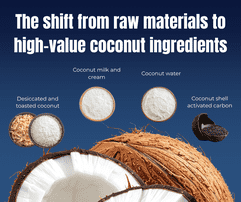
The shift from raw materials to high-value coconut ingredients
Historically, coconuts were exported primarily in raw or minimally processed forms. Today, the strongest growth is coming from processed coconut products designed to meet the technical and operational needs of modern manufacturers.
These include formats, such as:
- Desiccated and toasted coconut
- Coconut milk and cream derivatives
- Coconut water-based ingredients
- Coconut shell-derived materials, including activated carbon.
For B2B buyers, these products offer advantages that extend beyond functionality.
What are the key decision factors?

Consistency, longer shelf life, and ease of integration into existing production systems make processing expertise just as important as agricultural origin.
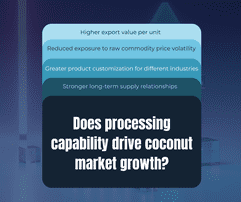
Does processing capability drive coconut market growth?
Regions and suppliers that invest in coconut processing infrastructure are gaining a competitive edge in the global market. By moving beyond raw coconut exports, they can deliver higher-value ingredients that align with international quality expectations and regulatory requirements.
This transition supports:
- Higher export value per unit
- Reduced exposure to raw commodity price volatility
- Greater product customization for different industries
- Stronger long-term supply relationships.
From a sourcing perspective, working with suppliers that control or closely manage processing reduces operational risk and improves supply-chain efficiency.
Ongoing challenges in coconut sourcing
Despite the industry’s growth, coconut supply chains remain complex. Also, fragmented farming systems, weather variability, and uneven adoption of modern agricultural practices can affect consistency and availability. These challenges reinforce the importance of supplier selection, particularly for businesses that rely on coconut ingredients at scale.
For buyers, this means prioritizing partners who actively manage their sourcing networks, maintain quality controls, and demonstrate the ability to scale in line with customer demand.
Conclusion: Shifting priorities in global coconut sourcing
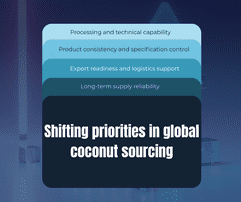
As coconut products continue to gain relevance across multiple sectors, sourcing strategies are evolving. Although price remains important, it is no longer the sole driver.
Increasingly, buyers are evaluating suppliers based on:
- Processing and technical capability
- Product consistency and specification control
- Export readiness and logistics support
- Long-term supply reliability.
In this environment, suppliers that combine deep origin knowledge with value-added processing are shaping the next phase of the coconut market.
Source coconut ingredients built for scale
As the global coconut market continues to shift toward processed, high-value formats, supplier capability plays a critical role in long-term success. Furthermore, businesses that work with partners offering consistency, processing expertise, and export readiness are better positioned to manage growth with confidence.
The Coconut Cooperative supplies value-added coconut products for manufacturers, distributors, and foodservice buyers worldwide. If you are reviewing suppliers or planning your next sourcing cycle, explore our coconut product range or connect with our team to discuss volumes, specifications, and logistics requirements.
References and resources

- Mordor Intelligence (2025) – Coconut Derivatives Market Size, Share & 2030 Trends Report.
- Spherical Insights (2025) – United States Coconut Products Market Size, Share, Trends, Growth.
- The Star (2025) – Unlocking billion-dollar potential for coconuts.


