
What do businesses need to know about the EU’s Deforestation Regulation (EUDR)?

The upcoming European Union’s Deforestation Regulation (EUDR) is set to reshape global commodity trade. Designed to curb deforestation linked to agricultural products, the EUDR is already influencing procurement decisions across industries that depend on raw materials like palm oil, soy, cocoa, coffee, rubber, cattle, and wood. The EUDR will take effect on December 30, 2025.
For businesses sourcing plant-based oils and derivatives, understanding the implications of this regulation is essential to navigating the evolving trade environment.
What the EUDR means for global supply chains

The EUDR requires companies placing certain commodities on the EU market to prove that their products are deforestation-free and legally produced. This includes extensive traceability and documentation, from the exact location of origin to proof that the production process complies with environmental and human rights standards.
This level of compliance introduces new logistical and cost burdens for importers, traders, and manufacturers. Thus, many are reassessing their sourcing strategies to:
- Mitigate risk
- Avoid supply disruptions
- Maintain compliance ahead of the deadline.
Commodities affected by the EUDR
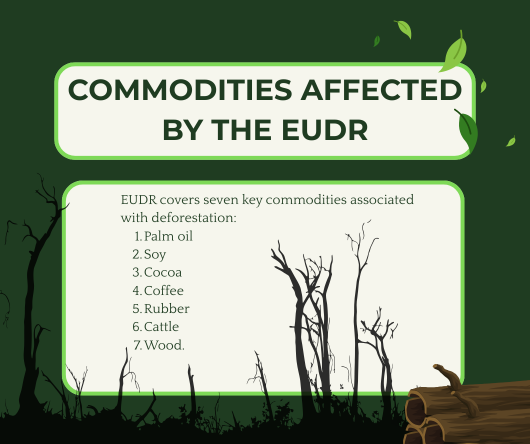
The regulation covers seven key commodities associated with deforestation, including:
- Palm oil
- Soy
- Cocoa
- Coffee
- Rubber
- Cattle
- Wood.
Products derived from these raw materials, such as margarine, chocolate, animal feed, and rubber goods, fall within the same regulatory scope. Moreover, this broad coverage means that the EUDR’s impact will extend far beyond primary producers, influencing food manufacturers, cosmetic brands, and even logistics operators.
Rising compliance costs and market adjustments
Industry analysts anticipate increased compliance costs across affected sectors as companies implement geolocation tracking, due diligence systems, and documentation frameworks. Small and medium enterprises may face particular challenges, while large multinationals are investing heavily in traceability tools to meet the new requirements.
As these compliance pressures build, buyers are already exploring alternative raw materials that are not covered by the EUDR but still meet sustainability expectations. This is where coconut-based ingredients are beginning to capture greater market attention.
The shift toward non-regulated oils
Palm oil remains the most widely traded vegetable oil globally. However, its inclusion in the EUDR has prompted businesses to look at other plant-derived oils. Among the options gaining traction are coconut oil and its derivatives. This is mainly because they are currently excluded from the EUDR’s commodity list.
This exemption gives coconut products a regulatory advantage, allowing importers and manufacturers to maintain business continuity without the added administrative complexity tied to deforestation compliance. Also, it creates opportunities for suppliers in coconut-producing countries like the Philippines, Indonesia, and Sri Lanka to strengthen their position in the international market.
Preparing for the EUDR implementation

With less than a year to go before the EUDR takes effect, businesses across the supply chain are encouraged to:
- Review their sourcing policies and supplier documentation
- Map existing supply chains for traceability readiness
- Identify alternative suppliers for high-risk commodities
- Stay informed about evolving EU guidance and compliance tools.
Companies that act early will be better positioned to manage risk and take advantage of emerging opportunities in more resilient, sustainable markets.
Conclusion: From regulation to coconut business opportunities
The EU Deforestation Regulation (EUDR) represents one of the most significant shifts in global agricultural trade policy in recent years. While it introduces challenges for several key commodities, it also opens the door for others to rise in relevance.
As buyers and manufacturers adapt to these new trade dynamics, coconut-based ingredients stand out as a stable, compliant, and increasingly strategic choice for long-term sourcing.
References and resources

- European Commission (2025) – Regulation on Deforestation-free products – Environment.
- International Institute for Sustainable Development (2025) – Unpacking the European Union Deforestation Regulation: An overview of the requirements for operators and small and medium-sized.
- World Resources Institute (2025) – What Is the EU Deforestation Regulation (EUDR)?


