
The coconut buying window is open: Why businesses should secure supply before Q4
For much of the past year, buyers of coconut ingredients have navigated a market shaped by elevated pricing, supply chain disruptions, and uncertainty. As we move through June 2026, the landscape looks noticeably different.
Pricing across much of the coconut ingredient market has continued to ease, extending a downward trend that began in the fourth quarter of 2025. For manufacturers, distributors, foodservice operators, and brands that rely on coconut-based ingredients, current market conditions present a valuable opportunity to secure inventory before seasonal demand begins to build.
While pricing remains favorable today, several market indicators suggest that this buying window may not remain open for long.
Why have coconut ingredient prices softened?
Several factors have contributed to lower coconut ingredient pricing throughout the first half of 2026.
Supply chains have largely stabilized following years of disruptions, allowing product flow to become more predictable. Demand has also normalized across many sectors, helping balance inventories throughout the market. Additionally, tariff relief and improved logistics conditions have reduced some of the cost pressures that affected importers over the past few years.
As a result, buyers have seen meaningful price relief across a wide range of coconut products, particularly within desiccated coconut formats, virgin coconut oil, and select coconut powder categories.
For businesses that have been working through higher-cost inventory purchased during previous market peaks, current pricing presents an opportunity to reset procurement costs and improve inventory positioning ahead of the second half of the year.
Factors that could increase coconut ingredient costs
Although current pricing remains attractive, several factors could begin putting upward pressure on costs as summer progresses.
Historically, demand for coconut ingredients increases significantly as manufacturers prepare for fall and holiday production schedules. This seasonal demand cycle often accelerates in late summer and continues through the fourth quarter.
Freight costs are also beginning to show signs of movement. Recent General Rate Increases (GRIs) affecting shipments from Southeast Asia have already contributed to higher transportation costs. While these increases remain manageable today, freight markets can shift quickly when demand rises.
Geopolitical developments also remain an important consideration. Ongoing tensions in the Middle East continue to create uncertainty around global energy and shipping markets. Any escalation could impact transportation costs and ultimately influence ingredient pricing worldwide.
Additionally, discussions surrounding potential new tariffs affecting multiple trading partners have introduced another layer of uncertainty. While no changes have been finalized, markets often begin adjusting expectations well before policy decisions are implemented.
Taken together, seasonality, freight volatility, geopolitical risk, and potential tariff developments suggest that the downside from current pricing levels may be limited, while the potential for upward movement grows as the year progresses.
Desiccated coconut remains one of the strongest buying opportunities
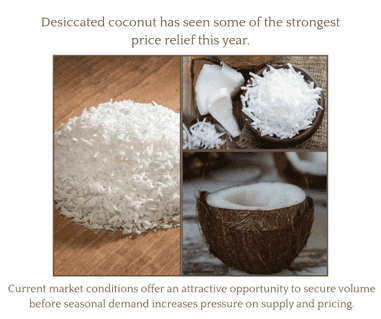
Among all coconut ingredient categories, desiccated coconut has experienced some of the most significant price relief since the start of the year.
Organic desiccated coconut medium and fine grades have seen substantial decreases compared to January pricing, while organic chips, toasted flakes, and chiplet formats have also continued to soften.
Much of this pricing relief can be attributed to the continued clearing of higher-cost inventory throughout the United States. As inventory purchased during previous market highs moves through the supply chain, buyers are benefiting from more competitive pricing.
For businesses with consistent usage of desiccated coconut ingredients, current market conditions offer an attractive opportunity to secure volume before seasonal demand begins placing additional pressure on availability and pricing.
Coconut milk powder, cream powder, and flour remain attractively priced
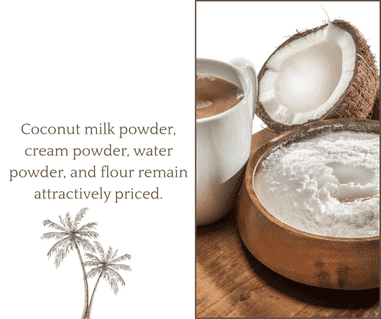
Coconut milk powder, coconut cream powder, coconut water powder, and coconut flour remain attractively priced relative to recent market conditions.
Organic coconut milk powder has continued to ease through the first half of 2026, creating opportunities for buyers seeking cost-effective inventory coverage. However, concerns surrounding harvest performance in Vietnam remain an important factor to monitor.
Organic coconut cream powder and coconut water powder have also experienced moderate price declines, contributing to favorable purchasing conditions across the powder category.
Meanwhile, organic coconut flour has returned to stock after previous periods of limited availability, providing additional sourcing flexibility for manufacturers and ingredient buyers.
For businesses planning production schedules into Q3 and Q4, current powder pricing may represent an opportunity to secure inventory before supply-side concerns begin influencing the market.
Is now the right time to buy organic virgin coconut oil?
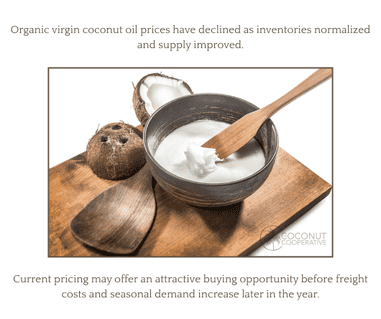
The coconut oil market has also seen meaningful price adjustments throughout 2026.
Organic virgin coconut oil has declined from January levels as importer inventories have normalized and supply conditions improved. Organic RBD coconut oil availability has also strengthened with additional inventory returning to the market.
Current pricing levels are approaching what many buyers consider a favorable purchasing territory, particularly for organizations evaluating larger volume commitments or future inventory coverage.
As freight costs and seasonal demand begin to increase later in the year, today’s market conditions may represent one of the more attractive buying opportunities available in 2026.
Coconut sugar supply may tighten before the fall season
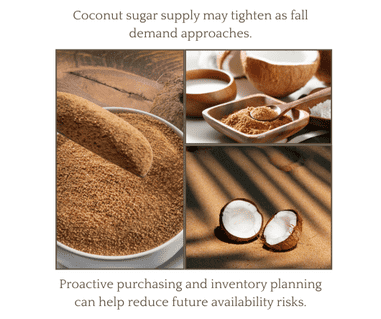
While many coconut ingredient categories continue to benefit from easing prices, coconut sugar presents a different outlook.
Supply conditions for organic coconut sugar have historically been more volatile than other coconut-derived ingredients, and early signs of tightening availability are beginning to emerge.
As businesses prepare for increased production heading into the fall season, coconut sugar is expected to be among the first categories where supply constraints become more noticeable.
For companies that regularly incorporate organic coconut sugar into their formulations, proactive purchasing and inventory planning may help reduce exposure to potential availability challenges later in the year.
How to prepare for Q3 and Q4 coconut ingredient demand
For procurement teams, ingredient buyers, and manufacturers, the current market presents a familiar challenge: balancing favorable pricing today against the risk of waiting too long.
The coconut market has delivered significant cost relief during the first half of 2026. However, the combination of seasonal demand, freight increases, geopolitical uncertainty, and potential trade policy changes suggests that conditions may become less favorable as the year progresses.
Businesses that secure coverage during the current buying window may be better positioned to manage costs, maintain inventory stability, and reduce exposure to potential market tightening later in the year.
Secure your coconut ingredient supply now

Current market conditions offer buyers an opportunity that has become increasingly rare in recent years: a relatively stable supply, improved availability, and pricing that has softened across much of the coconut ingredient portfolio.
While no market moves in a straight line, the factors that typically drive pricing higher are beginning to align. Seasonal demand is approaching, freight costs are showing signs of firming, and uncertainty remains present across global trade and logistics networks.
The Coconut Coop: Now is the best time to buy coconut ingredients in bulk
For businesses purchasing coconut ingredients in larger volumes, now may be the ideal time to evaluate inventory needs and secure coverage before the market shifts toward a tighter supply environment.
To discuss current pricing, volume opportunities, forward contracting options, or specific coconut ingredient requirements, contact us.
We’re here to help businesses navigate changing market conditions and build a supply strategy for the months ahead.
References and resources

- Food and Agriculture Organization of the United Nations (2025) – FAO Food Outlook points to broad-based increase in global food commodity production.
- UN Trade and Developement (2025) – Hormuz shipping disruptions raise risks for energy, fertilizers and vulnerable economies.
- Food and Agriculture Organization of the United Nations (2026) – Global Information and Early Warning System on Food and Agriculture.
- Reuters (2026) – World food prices slip in May, still near three-year high, FAO says.
- Reuters (2026) – Yemen’s Iran-backed Houthis threaten Israeli shipping in the Red Sea.


