
What is the role of coconuts in history and its impact on modern business?

Have you ever wondered if coconuts played a vital role in history? Well, in this blog, The Coconut Cooperative takes a look at the role of coconuts in history and their impact on modern business.
For centuries, coconuts have played a vital role in global trade, food production, and industry. From early maritime commerce to modern bulk supply chains, coconuts have remained an essential commodity. Today, businesses continue to leverage their versatility across multiple industries, from food manufacturing to cosmetics and beyond.
Coconuts in trade and commerce: The role of coconuts in history

Historically, coconuts were a valuable resource for seafarers and traders, who transported them across regions for their many uses. As global trade expanded, coconuts became an integral part of supply chains, valued for their long shelf life and diverse applications.
This legacy continues today, with businesses sourcing coconut products in bulk to meet increasing market demand.
Bulk coconut products in the modern market

Coconut derivatives such as oil, flour, water powder, and desiccated coconut are widely used in food production, beverage manufacturing, and personal care industries.
Companies that source high-quality coconut ingredients benefit from their efficiency in large-scale production, whether in baking, dairy alternatives, or plant-based product development.
Supply chain efficiency and global sourcing
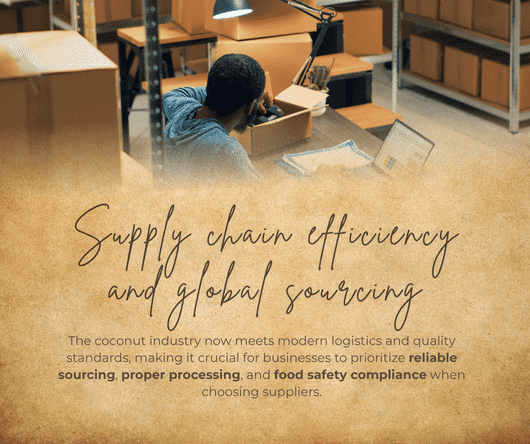
- The coconut industry has adapted to modern logistics and quality standards, ensuring a steady supply of raw and processed materials.
- Businesses looking to incorporate coconut products into their offerings must consider factors, such as:
- Sourcing reliability
- Processing methods
- Compliance with food safety standards.
- Establishing partnerships with reputable suppliers can streamline procurement and maintain consistency in product formulation.
The growing demand for coconut-based ingredients
As consumer preferences shift, businesses are increasingly investing in coconut-based alternatives. Food manufacturers are using coconut flour and sugar in baking and snack production, while beverage companies incorporate coconut water powder in hydration products.
Additionally, the cosmetic industry continues to explore coconut-derived ingredients for personal care formulations.
Why businesses choose coconut products
Companies looking for sustainable, high-demand ingredients recognize the strategic advantages of coconut-based products. Their diverse applications, stable supply chains, and adaptability to various industries make them an attractive choice for manufacturers and wholesalers.
At The Coconut Cooperative, we help businesses source high-quality coconut products in bulk. Whether you are in food production, beverage manufacturing, or other industries, we provide solutions tailored to your needs.
Contact us today to explore how coconut products can enhance your business operations. Alternatively, you may click here for more information on our wide range of all-organic coconut products and ingredients.
References and resources

- Diana Lutz (2011) – Deep history of coconuts decoded.
- Food and Fertilizer Technology Center for the Asian and Pacific Region (2022) – Business Potential of Coconut-based Products in the Global Markets.
- KAP (2024) – The Future of Coconut Production: Innovation and Sustainability in the Coconut Industry.
- Ramírez et al. (2023) – Innovations and trends in the coconut agroindustry supply chain: A technological surveillance and foresight analysis.


