
Japan partners with the ICC to build a more sustainable coconut industry

In a major step toward advancing a greener, more resilient global coconut sector, the International Coconut Community (ICC) recently engaged in high-level discussions with Japanese partners. Their goal? To accelerate sustainable development, innovation, and responsible trade across the coconut industry.
In this blog, The Coconut Cooperative explores the key outcomes of the ICC’s visit to Japan, including efforts to strengthen coconut supply chains, promote sustainability standards, support research and innovation, and unlock new uses for coconut byproducts in renewable energy and carbon offset initiatives.
International partnerships to strengthen global coconut supply chains
Facilitated by the Green Power Development Corporation of Japan (GPDJ) and the International Japan Business Network (IJBNET), the ICC’s visit to Japan highlighted the importance of global cooperation. These discussions brought together government agencies, private companies, and researchers to build supply chains rooted in transparency, traceability, and long-term resilience.
Coconut innovation takes center stage at Osaka Expo 2025

During their visit, the ICC delegation toured the site of the upcoming Osaka Expo 2025, themed “Designing Future Society for Our Lives”. The event aims to showcase technologies that improve sustainability, health, and well-being.
Coconut-based innovations are expected to play a role in shaping solutions for a better future.
Sourcing coconut shell charcoal for renewable energy

At Osaka Gas Chemicals Co., Ltd. (OGC), the delegation explored the use of coconut shell charcoal in activated carbon production. Emphasis was placed on sourcing sustainably and supporting replanting programs. This is to secure long-term raw material supply, which is a priority for producers and buyers alike.
Why global coconut certification matters

Traceability and compliance with global sustainability standards are becoming critical. Japanese company Sakamoto Yakuhin Kogyo Co., Ltd. stressed the need for a global coconut certification system to meet increasing regulatory demands, such as the European Union Deforestation Regulation (EUDR).
Celebrating ethical coconut entrepreneurship in Japan

Additionally, a visit to Cocowell Ice Cream Shop in Osaka demonstrated how coconut products can succeed in niche markets through ethical sourcing and social entrepreneurship.
Cocowell’s story highlights the potential for coconut to make a difference not just in food systems, but in the lives of smallholder farmers.
Coconut as a renewable aviation fuel feedstock
In meetings with Japan’s Ministry of Land, Infrastructure, Transport and Tourism (MLIT), discussions focused on using non-standard coconuts and Grade D copra as feedstock for Sustainable Aviation Fuel (SAF).
This promising avenue could also help diversify coconut applications while supporting the aviation industry’s decarbonization goals.
Research into coconut biofuel and genetic improvements

Furthermore, the Tokyo University of Agriculture and Technology (TUAT) is conducting research on coconut oil as an aviation biofuel and developing tissue culture techniques for coconut breeding.
These innovations are essential for boosting coconut yields, as well as enhancing genetic diversity and meeting growing global demand.
Toward a carbon-neutral coconut supply chain
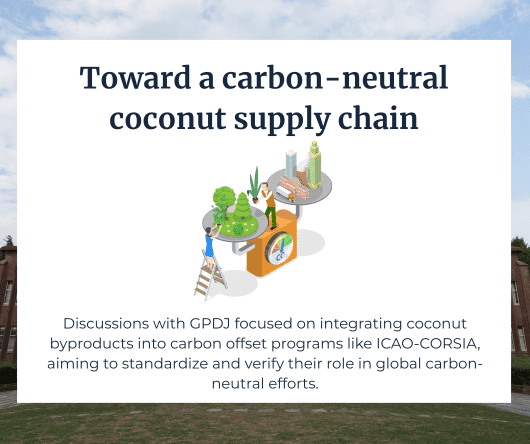
Further talks with GPDJ involved integrating coconut-derived byproducts into international frameworks such as the ICAO-CORSIA program. This program supports verified carbon offsetting for aviation.
Efforts are underway to standardize and verify the use of coconut materials in carbon-neutral initiatives.
Conclusion: A step toward a sustainable coconut future

The partnership between Japan and the ICC highlights how cross-border collaboration can advance the coconut industry toward greater sustainability, innovation, and traceability. As coconut continues to evolve from a traditional commodity into a key ingredient in global solutions, initiatives like this are paving the way for a stronger, more responsible future.
Read the full article on the International Coconut Community’s website: Global Partnerships in Focus.
References and resources

- Green Power Development Corporation of Japan (2025) – Green Power Development Corporation of Japan.
- International Coconut Community (2025) – Japan and ICC Lead the Coconut Industry Toward a Sustainable Future.
- Ministry of Land, Infrastructure, Transport and Tourism (2025) – Ministry of Land, Infrastructure, Transport and Tourism.
- Osaka Gas Chemicals Co., Ltd. (2025) – Osaka Gas Chemicals Co., Ltd.
- Tokyo University of Agriculture and Technology (2025) – Tokyo University of Agriculture and Technology.


