
Why is coconut oil poised to benefit from the EU’s new deforestation policy?
As the EU Deforestation Regulation (EUDR) nears its implementation deadline on December 30, 2025, the global edible oils market is undergoing a quiet but significant transformation. While major commodities like palm, soy, and cocoa are preparing for tighter compliance requirements, coconut-based products stand apart and ahead.
Coconut oil’s exclusion from the EUDR gives it a unique competitive advantage, positioning it as one of the few major plant-based oils not subject to the same traceability and deforestation rules that are reshaping global supply chains.
Coconut products are not covered by the EUDR
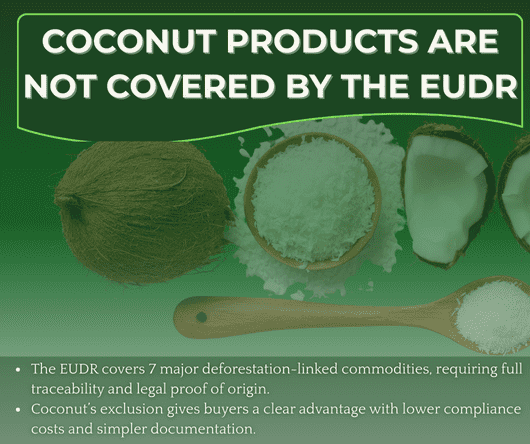
The EUDR targets seven commodities linked to deforestation, including:
- Palm oil
- Soy
- Cocoa
- Coffee
- Rubber
- Cattle
- Wood.
Under these rules, companies importing or trading these products in the EU must demonstrate that their goods are deforestation-free, legally produced, and fully traceable to their point of origin.
Coconut, however, is not included in this list — a key distinction already influencing procurement decisions.
For buyers, this exemption translates to lower administrative costs, simpler documentation, and fewer compliance risks when compared with regulated commodities.
A shift in buyer interest
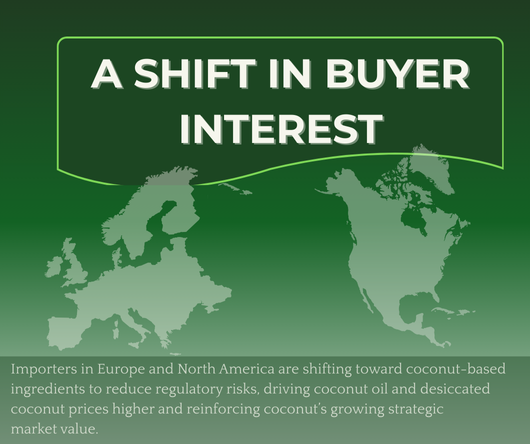
Industry observers note that some European and North American importers have begun reallocating orders toward coconut-derived ingredients such as coconut oil, desiccated coconut, and coconut milk powder.
This trend reflects both a desire to minimize regulatory exposure and a strategic diversification away from high-risk supply chains.
- Coconut oil prices rose from US$2,320/MT in January to US$2,750/MT in October.
- Desiccated coconut prices increased from US$1.45/lb to US$1.90/lb in the same period.
Behind these figures lies a clear message: demand is strengthening, and the coconut market positioning is becoming more strategically valuable each quarter.
Weather and supply dynamics
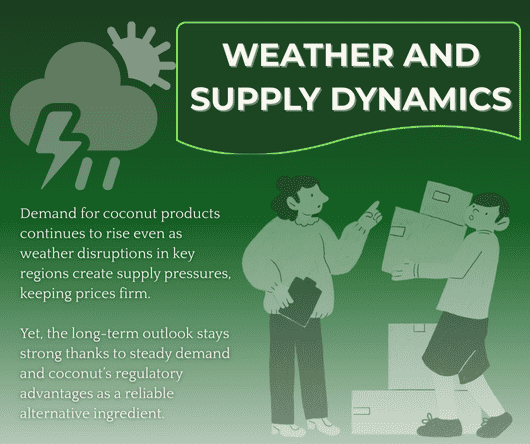
While demand continues to grow, supply has faced periodic pressure from weather-related disruptions in major producing regions like the Philippines and Indonesia. Typhoons and inconsistent rainfall patterns have affected copra harvests and logistics, maintaining a firm price tone through Q3–Q4 2025.
Despite these challenges, the long-term outlook remains bullish. Stable demand from the food, beverage, and personal care sectors continues to support coconut oil and its derivatives.
For many buyers, coconut’s supply consistency and regulatory exemption make it a dependable alternative amid tightening global compliance requirements.
A competitive edge in global trade

Coconut products’ exclusion from the EUDR offers a rare advantage in today’s regulation-driven marketplace. Businesses seeking to balance sustainability goals with operational efficiency increasingly view coconut oil as a low-risk, regulation-friendly ingredient that aligns with environmental priorities without adding compliance complexity.
For suppliers, this presents an opportunity to strengthen export relationships with compliance-conscious buyers. For manufacturers, it means access to a reliable, regulation-exempt material that fits seamlessly within both performance and sustainability frameworks.
Coconut oil: A smart, regulation-friendly choice for global buyers
As the EUDR takes effect, the global oils market is poised to rebalance. Regulated commodities may face short-term disruptions and higher costs, while coconut products are positioned to capture greater market share.
For businesses sourcing ingredients for food production, cosmetics, or industrial applications, coconut oil’s exemption from deforestation compliance offers both flexibility and strategic advantage. In an increasingly regulated world, that edge can make a meaningful difference.
The Coconut Cooperative supplies a wide range of high-quality coconut ingredients, including organic coconut oil, desiccated coconut, and coconut milk powder, responsibly sourced from trusted producers in Southeast Asia.
References and resources

- European Commission (2025) – Regulation on Deforestation-free products – Environment.
- International Institute for Sustainable Development (2025) – Unpacking the European Union Deforestation Regulation: An overview of the requirements for operators and small and medium-sized.
- World Resources Institute (2025) – What Is the EU Deforestation Regulation (EUDR)?
Related blogs

- The Coconut Cooperative (2025) – What businesses need to know about the EU’s Deforestation Regulation (EUDR).


