
Why do coconuts have three holes?

Have you ever noticed the three little “eyes” on a coconut and wondered what they’re for? These markings have sparked curiosity for generations, from tropical farmers to travelers cracking open coconuts on the beach. While they might look like random dots, these “holes” actually serve an important biological purpose that reveals just how clever nature can be.
In this blog, The Coconut Cooperative uncovers why coconuts have three holes, what role they play in the coconut’s growth and structure, and how this small detail connects to both everyday use and large-scale coconut production.
The science behind the coconut’s holes

The three dark circles on a coconut’s shell are called germination pores. Out of the three, only one is functional: the germ pore. It is where the shoot of a new coconut seedling eventually sprouts.
The two other holes are often referred to as “blind eyes” or the non-functional pores. These pores form naturally as the coconut develops.
Once the fruit matures, the shell hardens, leaving behind three visible spots that play a key role in the coconut’s ability to grow, float, and spread across tropical shores.
How are the coconut’s holes used?

In nature, the germ pore is the coconut’s exit point for new life. When a seed germinates, the shoot pushes through this softer spot to begin its journey as a new tree.
Humans, too, have found practical uses for these natural design features:
- The “eyes” are the easiest access points for extracting coconut water.
- Farmers and processors use them to inspect maturity and freshness.
- Traditional tools for cracking coconuts often target these softer areas to make the process easier.
Hence, nature truly designed the coconut to be both resilient and resourceful.
Fun facts about the coconut’s eyes
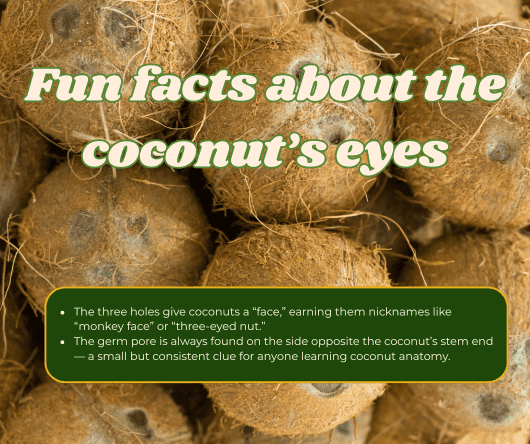
- The three holes give coconuts a “face,” earning them nicknames like “monkey face” or “three-eyed nut.”
- Some cultures see symbolic meaning in the three eyes, such as representing life, renewal, or nature’s watchful spirit.
- The germ pore is always found on the side opposite the coconut’s stem end — a small but consistent clue for anyone learning coconut anatomy.
From curiosity to commerce: The coconut’s journey

Understanding the anatomy of a coconut isn’t just trivia. It’s definitely valuable knowledge for the coconut industry.
- In processing facilities, machines are often designed to pierce coconuts at the germ pore for efficient water extraction.
- Quality inspectors look at the “eyes” to check for signs of spoilage or cracks.
- Even packaging and grading systems benefit from understanding how these natural features affect durability and freshness.
It’s a perfect example of how small natural details have a big impact on the global coconut trade and production.
Conclusion: More than meets the eye

Those three little holes are more than a quirky detail. They are definitely nature’s blueprint for survival, growth, and regeneration. Each one tells a story of how coconuts adapt, travel, and sustain life across tropical coasts.
So, the next time you hold a coconut, take a closer look at its “eyes.” What seems like a simple design is actually one of nature’s clever ways of keeping life moving forward.
The Coconut Cooperative: Your partner in quality and knowledge

At The Coconut Cooperative, we believe that understanding the coconut from its anatomy to its applications is key to delivering products that businesses can trust.
We work with dedicated growers and processors who share our commitment to quality and sustainability. From organic coconut sugar and toasted coconut flakes to coconut water and milk powder, our wide range of coconut products is crafted to meet the needs of manufacturers, culinary innovators, and wholesale buyers around the world.
Because like the coconut itself, our work is built on nature’s wisdom and designed to help your business grow.
References and resources

- Harries, Hugh C. (2012) – Germination rate is the significant characteristic determining coconut palm diversity.
- Beveridge, et al. (2022) – Fruit Biology of Coconut (Cocos nucifera L.).
- ScienceDirect (2024) – Coconut – an overview.


