
Coconut shortage in Sri Lanka: Navigating surging demand and declining yields

The coconut industry is facing a tough balancing act: growing demand on one side and declining yields on the other. In Sri Lanka, where coconuts are a staple in homes and businesses alike, this challenge has sparked serious discussions among industry leaders, farmers, and government authorities.
In this article, The Coconut Cooperative explores the reasons behind the declining coconut yields, the measures being taken to address the supply shortage, and the potential long-term solutions for stabilizing the industry.
What’s causing the drop in yields? And, what’s being done to ensure supply meets demand? Let’s dive in.
The coconut supply crunch
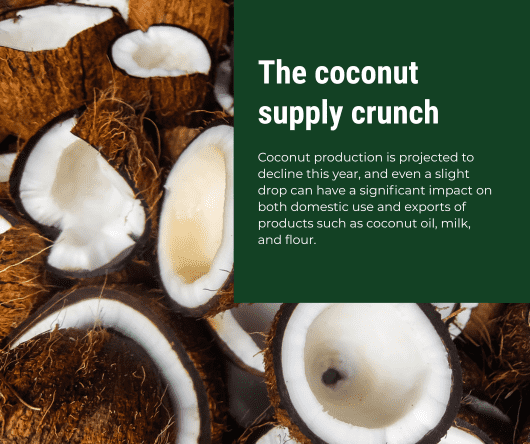
Coconut farmers are experiencing lower-than-expected coconut harvests, particularly in the March-April season. While there’s hope for an improvement from May to July, projections still indicate a decline, with coconut production expected to decrease from 2.7 billion nuts in 2024 to approximately 2.6 billion in 2025.
Even a small reduction can have widespread effects, which can then impact both local consumption and exports of coconut-based products such as coconut oil, milk, and flour.
Imports: A stopgap solution
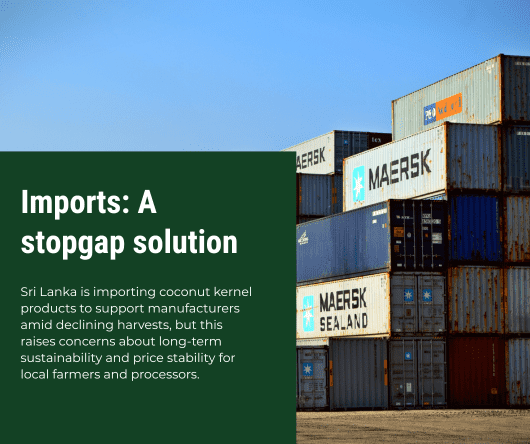
To bridge the gap, Sri Lankan authorities have allowed the importation of coconut kernel products, including desiccated coconut, coconut cream, and milk powder. This move aims to support local manufacturers who rely on a steady coconut supply.
However, while imports can provide temporary relief, they also raise concerns among farmers and processors about long-term industry sustainability and price fluctuations.
Price fluctuations and grower concerns

- Coconut prices have been on a rollercoaster ride. At one point, nuts were selling for over Rs. 200 each, only to drop to around Rs. 140 recently.
- Lower prices might seem like good news for buyers, but for coconut growers, it’s a different story.
- With reduced yields and declining income, many farmers are worried about making ends meet.
Fertilizer subsidy from the government
To help improve future yields, the government has launched a fertilizer subsidy program aimed at small-scale coconut farmers. Here’s how it works:
- Eligible growers, those with land between ¼ acre and 5 acres, can access subsidized fertilizer.
- A 50 kg bag of fertilizer, normally priced at Rs. 9,000, will be available for Rs. 4,000.
- The government has allocated Rs. 5.6 billion for this initiative, covering 56,700 metric tons of fertilizer.
- Officials expect that farmers who apply the fertilizer now will start seeing improved coconut yields within the next 1.5 years.
Conclusion: The road ahead for the Sri Lankan coconut sector
While short-term solutions like imports and subsidies offer some relief, long-term strategies are crucial for stabilizing the coconut industry. Authorities, businesses, and farmers must work together to enhance farming techniques, invest in sustainable practices, and ensure a reliable supply chain. After all, coconuts are more than just a commodity; they are now an essential part of industries worldwide.
As discussions continue, one thing is clear: securing the future of coconuts requires both immediate action and forward-thinking solutions.
References and resources

- The Sunday Times (2025) – Authorities grapple with surging demand, low coconut yields.
- News.lk (2025) – The reason for the coconut shortage is that no government has had a proper policy to develop coconut cultivation – PM.
Related blogs

- The Coconut Cooperative (2024) – Diving deep into coconut supply and demand as 2024 concludes.
- The Coconut Cooperative (2024) – Navigating coconut supply chain challenges during El Niño.
- The Coconut Cooperative (2025) – Business insights: Key trends and challenges in the coconut industry.
- The Coconut Cooperative (2025) – Strengthening the coconut industry amid global challenges.
- The Coconut Cooperative (2025) – The 2025 coconut market forecast: Trends, challenges, and opportunities.


