
Eco-friendly coconut products for sustainable sourcing

As sustainability moves from a buzzword to a cornerstone of ethical business practices, companies are increasingly looking for suppliers and products that align with environmentally-friendly values. Coconut products, with their low-impact growth and versatile byproducts, have become a popular choice for businesses aiming to support sustainable sourcing.
Join us as we take a closer look at why using coconut products is an eco-friendly choice that helps reduce environmental impact.
Why are coconut products a sustainable choice?

1. Low environment impact on growth
Coconut palms are remarkably efficient plants with minimal water and maintenance requirements.
Unlike other tropical crops, coconut trees need less irrigation and grow well in diverse climates, which minimizes reliance on additional resources. This adaptability also lessens the need for artificial fertilizers and pesticides, which can have damaging environmental effects over time.
By supporting the use of coconut products, companies are choosing a crop that grows efficiently and with less environmental strain.
2. High yield with minimal waste
One of the most sustainable aspects of coconuts is that almost every part of it can be utilized, resulting in minimal waste.
Coconut flesh, milk, and water are common components in food and beverage products, while its other parts such as shells and husks are repurposed for various uses. This “whole coconut” approach reduces waste in production and maximizes the resource’s potential.
Companies that use coconut products are, in effect, supporting a low-waste industry that fully values its raw materials.
Natural decomposition of coconut byproducts

Coconut-based products are naturally biodegradable. This means that they break down over time without leaving harmful residues.
Items, such as coconut bowls, utensils, and coir products, used in gardening and agriculture will decompose without adding to the mounting landfill waste of synthetic materials. This stands in contrast to plastic or other non-renewable materials that can take centuries to break down, making coconut products an eco-friendly choice for businesses aiming to reduce their waste footprint.
Waste-to-value solutions
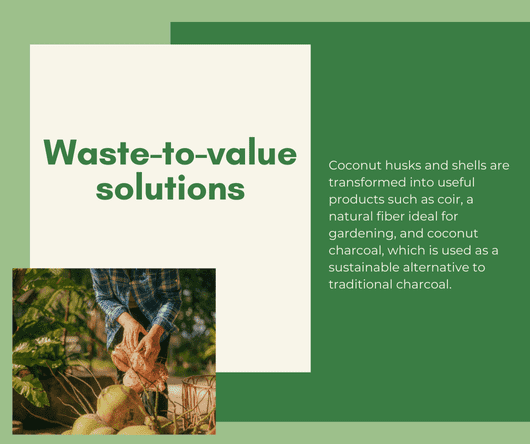
In addition to being biodegradable, many byproducts from coconuts are valuable in other industries.
For example, coconut husks and shells are transformed into useful products such as coir, a natural fiber ideal for gardening, and coconut charcoal, which is used as a sustainable alternative to traditional charcoal.
These solutions create value from materials that might otherwise go to waste, supporting a circular economy where byproducts find new life in other applications.
Carbon capture and climate resilience
As coconut trees provide high yields with low input, they also contribute to carbon capture. As they grow, coconut trees naturally capture carbon dioxide from the atmosphere, helping offset emissions and produce oxygen. This makes coconut farming a valuable ally in the global effort to reduce greenhouse gases.
Sustainability in coconut farming

Many coconut farms today employ regenerative practices that restore soil health and promote biodiversity. Techniques such as agroforestry, where coconut trees are grown alongside other plants, enhance the resilience of farms by diversifying crops, enriching the soil, and creating more stable ecosystems.
By sourcing from these farms, companies can indirectly support more sustainable farming techniques that contribute positively to the environment.
Empowering coconut farmers
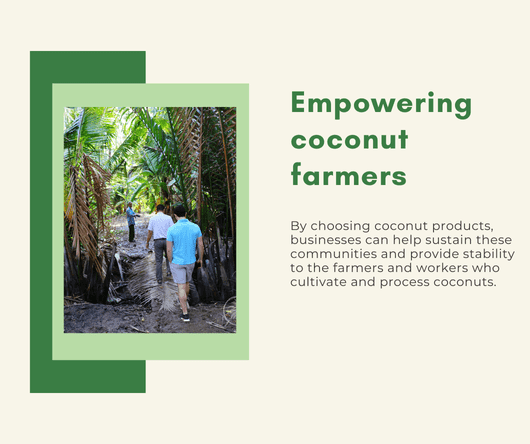
Coconut farming plays a crucial role in supporting local economies and creating jobs. By choosing coconut products, businesses can help sustain these communities and provide stability to the farmers and workers who cultivate and process coconuts.
In this way, the demand for coconut products is a powerful force in promoting economic resilience and social benefits within coconut-producing regions.
Conclusion: Make the eco-friendly switch with coconut products

As companies seek sustainable sourcing options, coconut products offer a truly eco-friendly alternative. With minimal environmental impact, zero-waste potential, and positive contributions to carbon capture and local communities, coconuts support a sustainable future from growth to disposal.
By incorporating coconut products into sourcing decisions, businesses can make strides toward greener operations that benefit the planet, people, and profit.
Click here to learn more about our wide range of high-quality, all-organic coconut products and ingredients. Partner with us today, click here to contact us.
References and resources

- BSR (2023) – Sustainable Coconut Partnership: Toward a Responsible and Resilient Sector.
- V.V. Namitha, Sheeja K. Raj, K. Prathapan (2022) – Carbon Sequestration Potential in Coconut based Cropping System: A Review.


